

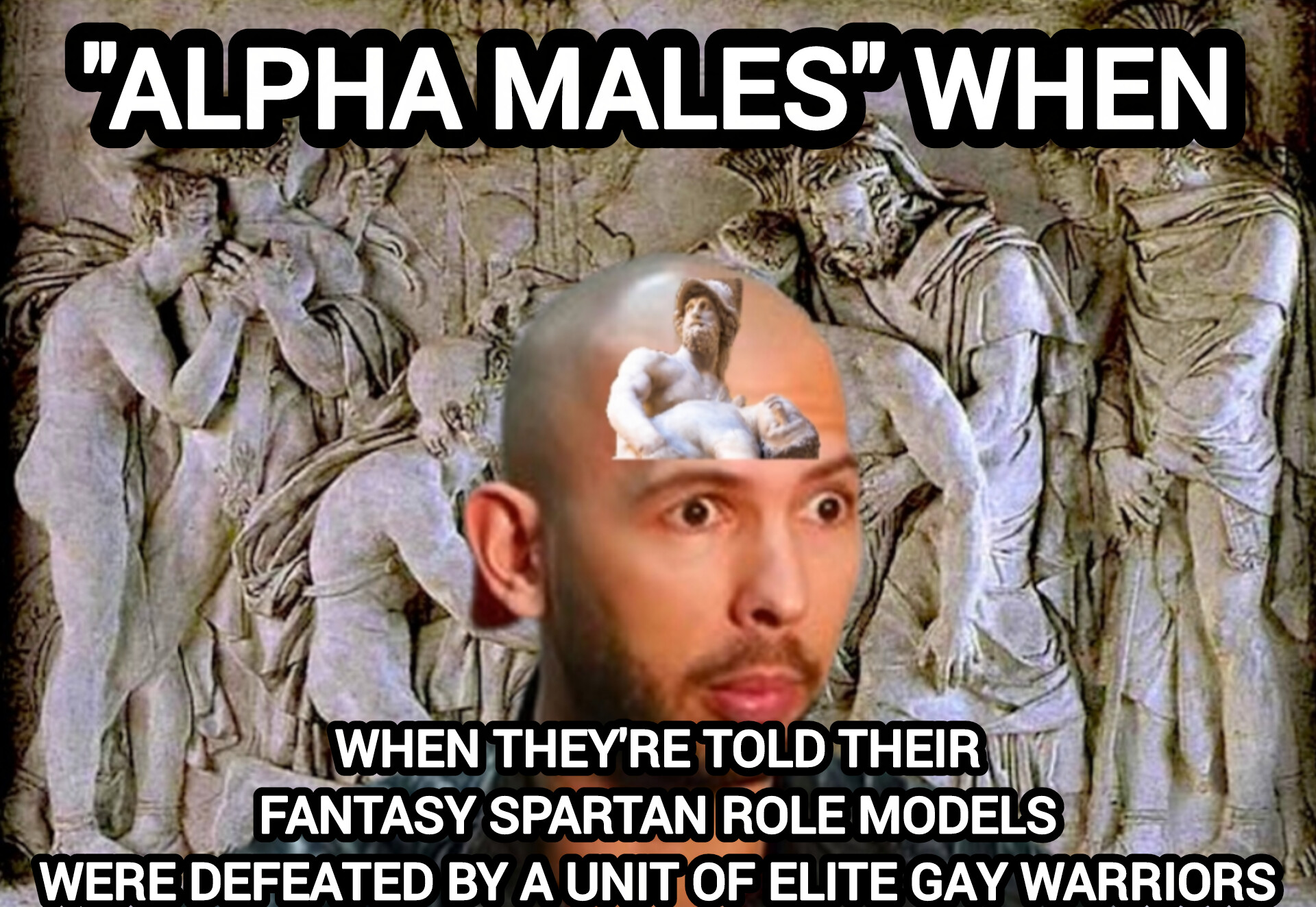
Context: in classical Greece, Sparta built a hegemony based on its military power that was formed around a core of professional hoplites, which was rare at the time as most military campaigns were fought by part time soldiers who were mainly farmers, handymen, etc.
This hegemony was broken when in Thebes the Sacred Band of Thebes was formed, consisting of 150 gay couples who became professional soldiers, too. These 300 (coincidence? Idk, but I find it funny) elite warriors were instrumental in two major defeats an outnumbered thebian army handed to Spartans who encountered another professional military for the first time.
The Sacred Band being made up of gay couples was intentional, as the idea behind it was that men would fight harder for and with other men they had a strong bond with and there was no stronger bond than love.
Idolizing spartan warrior culture is widespread among “alpha males” and the manosphere. Another funny irony that followers and propagators of such a homophobic idiology idolize a culture that was defeated by an explicitly gay warrior unit.
Rome came much later.
The mindset is actually still alive today. A lot of central and south american countries still have this mindset due to Portuguese and Spanish influence over the centuries. I watched a documentary years back talking about the history and origins of machismo in Latin culture.