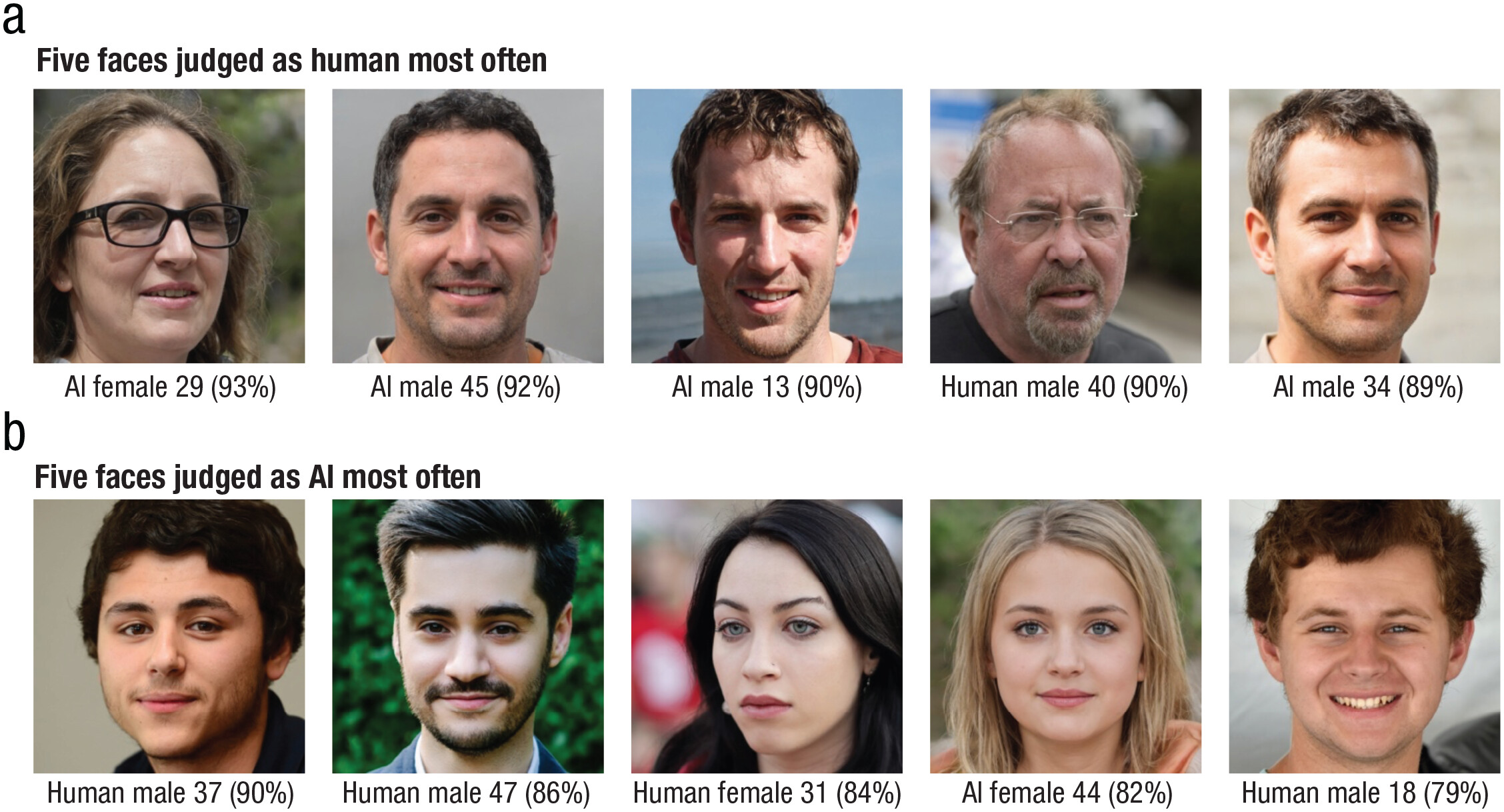
We used the 100 AI and 100 human White faces (half male, half female) from Nightingale and Farid. The AI faces were generated using StyleGAN2. The human faces were selected from the Flickr-Faces-HQ Dataset to match each of the AI faces as closely as possible (e.g., same gender, posture, and expression). All stimuli had blurred or mostly plain backgrounds, and AI faces were screened to ensure they had no obvious rendering artifacts (e.g., no extra faces in background). Screening for artifacts mimics how real-world users screen AI faces, either as scientists or for public use, and therefore captures the type and range of stimuli that appear online. Participants were asked to resize their screen so that stimuli had a visual angle of 12° wide × 12° high at ~50 cm viewing distance.
I don’t know why people (not saying you, more directed at the top commenter) keep acting like cherry picking AI images in these studies invalidate the results - cherry picking is how you use AI image generation tools, that’s why most will (or can) generate several at once so you can pick the best one. If a malicious actor was trying to fool people, of course they’d use the most “real” looking ones, instead of just the first to generate
Frankly the studies would be useless if they didn’t cherry pick, because it wouldn’t line up with real world usage
I understand why you’re cautious in the “accusation” (don’t put too much weight on accusation, it’s just the idea I want to convey, not any malicious intent) but in this case, I am saying that cherry picking invalidates the findings, as they are stated.
If the findings were framed around “it’s easier to fool people using white AI generated faces”, or something similar, I’d be on board with it. The way it sounds right now is “AI generated faces don’t have all these artifacts 99% of the time” (I’m paraphrasing A LOT, but you get what I mean.)
The way it sounds right now is “AI generated faces don’t have all these artifacts 99% of the time” (I’m paraphrasing A LOT, but you get what I mean.)
The only way it sounds like that is if you don’t read the article at all and draw all your conclusions from just reading the title.
Don’t get me wrong, I’m sure many do just that, but that’s not the fault of the study. They clearly state their method for selecting (or “cherry picking”) images
They used a clickbaity title, they’ll get clickbaity judgement.
It’s also not in their abstract, which is supposed.to contain the most important facts. Their first sentence is about how AI generated faces are indistinguishable. No, they’re not. It’s like saying “writing random numbers solves any numerical equation”, not mentioning that I took a gazillion random numbers and did my study on the ones that matched.


I don’t know why people (not saying you, more directed at the top commenter) keep acting like cherry picking AI images in these studies invalidate the results - cherry picking is how you use AI image generation tools, that’s why most will (or can) generate several at once so you can pick the best one. If a malicious actor was trying to fool people, of course they’d use the most “real” looking ones, instead of just the first to generate
Frankly the studies would be useless if they didn’t cherry pick, because it wouldn’t line up with real world usage
I understand why you’re cautious in the “accusation” (don’t put too much weight on accusation, it’s just the idea I want to convey, not any malicious intent) but in this case, I am saying that cherry picking invalidates the findings, as they are stated.
If the findings were framed around “it’s easier to fool people using white AI generated faces”, or something similar, I’d be on board with it. The way it sounds right now is “AI generated faces don’t have all these artifacts 99% of the time” (I’m paraphrasing A LOT, but you get what I mean.)
The only way it sounds like that is if you don’t read the article at all and draw all your conclusions from just reading the title.
Don’t get me wrong, I’m sure many do just that, but that’s not the fault of the study. They clearly state their method for selecting (or “cherry picking”) images
They used a clickbaity title, they’ll get clickbaity judgement.
It’s also not in their abstract, which is supposed.to contain the most important facts. Their first sentence is about how AI generated faces are indistinguishable. No, they’re not. It’s like saying “writing random numbers solves any numerical equation”, not mentioning that I took a gazillion random numbers and did my study on the ones that matched.