Anyone else using Mac minis as VM hosts for self hosting? My Friendica server is a Linux VM on a Mac Mini in my living room. The VM is bound to a VLAN tagged network interface so it’s completely firewalled off from the rest of my network. Also got a second Linux VM on the same box for hosting local stuff on my main VLAN (HomeBridge/etc).
I feel like they’re really nice platforms for this, if not the cheapest. Cheaper than one might think though; I specced up an equivalent NUC and there wasn’t a lot of difference in price, and the M2 is really fast.
I specced up an equivalent NUC and there wasn’t a lot of difference in price, and the M2 is really fast.
How come? Second hand HP Mini should be cheaper…
“I specced up an equivalent NUC and there wasn’t a lot of difference in price, and the M2 is really fast.”
You must be putting a lot of stock in the CPU and 10G Ethernet. Because the pricing on storage and RAM, which are much more important resources in most self-hosting scenarios, differ an extreme amount since you can’t upgrade the RAM in the M-chip Minis. They also cap out at 32 GB which isn’t bad but half of what say AM4 can do. Power Efficiency is of course also great on the M-series chips which is worth something.
If we’re purely talking Intel NUCs then the i7s and i9s do get expensive but so does the M2 pro. M2 is absolutely faster than i5 and i3 but I can’t really imagine a use case where that would matter for self-hosting?
Seems slightly unnecessary unless you have loads lying around, I’m still using a 10 year old dual core i3 and it doesn’t sweat running 60 services, and I can expand the storage much more than a Mac mini.
I gave up on VMs ten years ago.
Containers on Linux metal, always.
I did think about this, but finally abandoned the idea for 3 reasons:
- Not much choice of hardware
- Unlikely to come across old hardware of that type to repurpose
- Much harder to move workloads from/to the cloud if necessary.
That being said, if I had a spare Mac mini I would probably have tried 🤓
@BornDeranged Honestly, moving stuff to the cloud is trivial. Everything is in containers and I can just setup the nginx reverse proxy that’s also running on the VLAN to redirect to the cloud. Job done.
Sure. But if I hosted on an Apple Silicon, I would use native services where available. And Apple Silicon in the cloud is harder to find.
@BornDeranged I’m running everything in containers. Not got anything which cares which architecture the server is. Data is data.
I want to do something like this
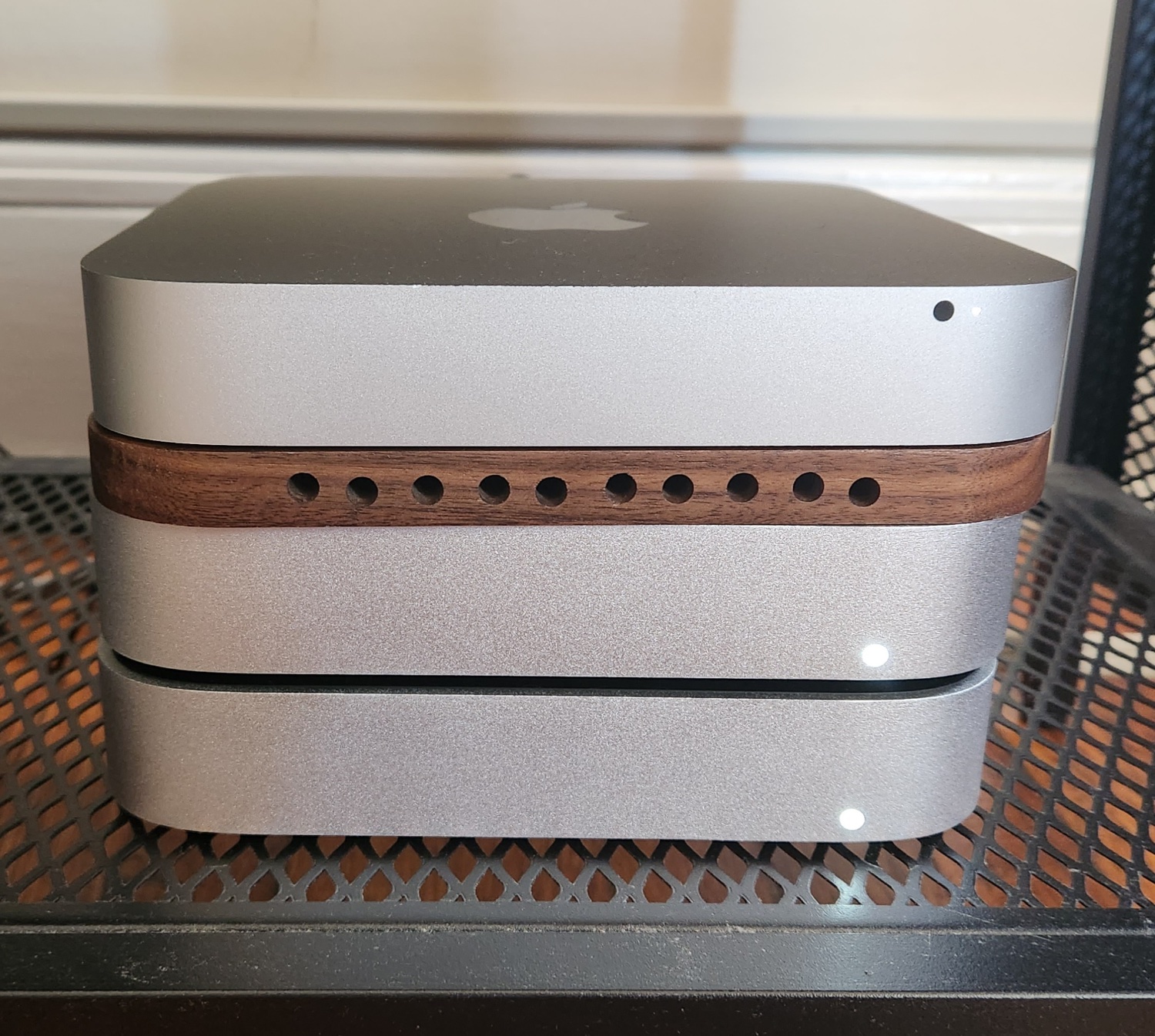 to replace my huge ass dual xenon and have less noise and electricity consumption.
I’m looking for a refurbished M1 Mac mini with 10Gbe but still out of luck.
Why the M1 and not M2 or 3 ? Price of course but also because Asahi Linux will work perfectly on M1 before the new chips.
This seems like so much unnecessary headache to run binaries that run perfectly fine on commodity hardware, the linux kernel, and x86 chips.
Well not really, I’m not the one working on making a native M* chip Linux (but those guys are indeed insanely crazy, they are reverse engineering Mac, writing hardware specs and even correcting bugs for Apple).
It’s just another cool geek project like you could do with a pi, and ofc have bonus geek point for having an Apple silicons run Linux natively.
Plus, I will be so glad to resell my huge 18kg supermicro server.
I’ve been thinking more and more about getting a Mac Mini specifically for this as well. They’re silent, not too power hungry and more than powerful enough, and I would just love scripting in Swift on there 😆 (but maybe that’s just me).
How long have you had it setup like this? And what’s your experience been so far?
@Skwiggs Few months. I was using an old laptop with Debian before but Friendica was cooking it, literally.
The M2 Mini doesn’t break a sweat. It just takes the load and gets on with it.