

13·
2 months agoFinally.
Finally.

I know this is a tiny percentage overall, but it’s a very substantial boost to the Linux percent, perhaps correlating with Win10 losing free security updates, and a minority of savvy gamers swapping to Linux. (Myself included, so obviously bias to my statement)
Okay that’s what was happening… yay

I mean preppers try to be as self sufficient as they can. Hosting your own stuff is similar to that, so yeah, I guess.
My outage was when the internet to my house was intermittent, not when AWS went down
So you admit you can block IPv6 traffic in your rebuke to IPv6 adoption. What’s then the issue? Block what you want, it’s your network, but do it with a firewall and not NAT.
Sure, nature took its course, but did NATs make things better? I’m a game dev and getting two computers to talk to each other is so so much harder due to NAT traversal, requiring punchthrough servers. Voice chat and stuff need STUN/TURN servers. A game has to account for “what if my host wants to connect two clients, one of which within the NAT and one without?”
Makes far more sense to give every device an address and just talk to it and leave security and port openness up to firewalls.
IPv4 is definitely a large part of the blame for this and we need to start resting the blame there in hopes we force these companies (and their users) to actually use it. We need ISPs to support it, of course for end users, but at the enterprise level everything should be IPv6. It should have been IPv6 a decade ago, or more.

I do know all of this, it’s just dedicated hardware for a step we’re currently simulating in shaders. Dedicated hardware that if I’m not mistaken exists on NVIDIA graphics cards already.
That’s an added capability, not a rethinking. But it will enable raytracing in a way that is far less expensive.
Yeah, not sure if “use upscaling, raytracing and compress a little more” counts as “rethinking”
JXL isn’t lossless by default but you can encode losslessly and still get meager to fair file size reduction compared to WebP or PNG.
PS5 is supposedly no longer sold at a loss.
That said, the margin per console is probably not good enough for their required profit growth, hence this.
The arch wiki is shockingly detailed at times. I’m very impressed.
Hi hello, this is partly me. My bad. I’m not moving to Win11 (by force and by choice) so I installed Arch just to start to get the hang of things and, well, now I’m just daily driving it.
I’ve run distributions in the distant past and toyed with recent ones. I think this one is staying though.
Feels good that when my computer is idle, it’s not busy spouting off telemetry to some server somewhere. I can customize way more than before, and with Proton, I can still play the games I want to.

Competition has grown in the industry and long-term live-service black hole games have captured parts of the potential purchase-base so wholly that they don’t really spend elsewhere.
Game companies have plenty of methods for bringing costs down, but making games faster gives you more attempts at a very competitive market. (Some) Indie games are sort of proving this right. If you make a relatively quality game in a short time period and release it for a relatively good price, you can get your foot in the door of the market. If you spend 5+ years making the biggest game you’ve ever made and it sucks, your studio dies.
The big question is if AAA shifts to making games faster, are they going to be of a high enough quality to justify the outrageous price publishers will still want to set for them? (easy: no)
Basically I see it as the industry splitting even further. The AAA games that make money will continue to do so only so long as their last game lets them float 5+ year dev cycles. Otherwise, companies and publishers are going to reduce risk and investment and push developers to make their game faster, get to market faster. Arguably that would be healthy for the industry, but I know it won’t be.
Pretty sure the dollar weakened by 10% over it being harder to trade with the US.
Well, that’s tariffs for you. Completely expected, though a ~10% bump on the PS5 doesn’t adjust for all the tariff increase IIRC.

I use gitea for my personal projects, though if you’re not already using it, forgejo (a fork) may be better (I don’t know).
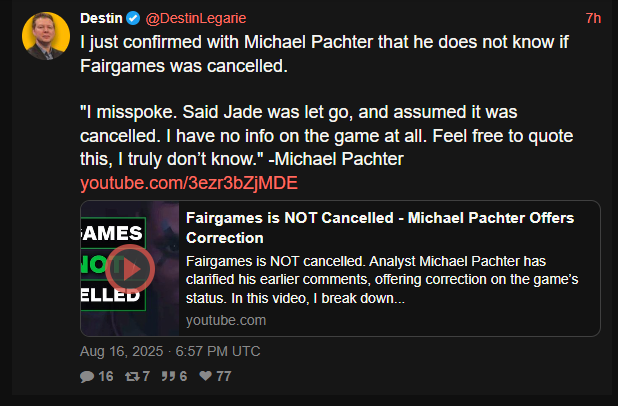
Apparently not canceled
Both Valve and Epic are private companies and thus have a bit more of a say over what they do than public companies would. Sweeney actually just answers to himself, and I mean that pejoratively, otherwise he would have invested in EGS more to compete with Steam and focused more on Unreal Engine’s near-monopoly in the AAA space.
Instead, he focused on “owning” the metaverse, and courting crypto. If I were a shareholder, I would say he wasn’t acting in my best interests.