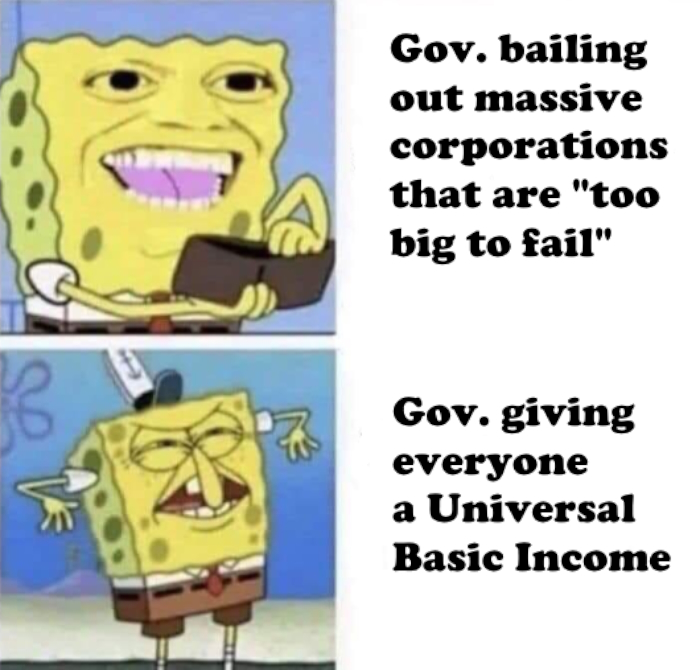

If a company is “too big to fail” the punishment should be that the government bails them out, then breaks it up into smaller parts that are free to fail or succeed naturally without government intervention
Just nationalize them. If the government has to bail them out then then the government just bought them. If a company is too big to fail then it’s too big to be privately owned.
The problem with that is that goverments are shit at running companies, so the ownership should always be <50%. But they should definitely get stock or bonds for the bailouts. And if selling less than 50% of the company off to the government won’t get them enough money to stay operating, they need to just give up.
I don’t want them to be nationalized though, I want them to be able to operate without needing government intervention, basically the exact opposite
Are you just talking about bailouts or regulations in general? Because businesses need to be regulated.
Just bailouts
Let them keep their control of the company, but give shares of the company to the American people who paid to bail them out.
Everyone gets dividends
Nationalize them and turn the former business into a 501:c3. Also fire the entire C-Suite, with cause to prevent any golden parachute payments.
But I was told that the rich leaders take risks!
…right?
What if we just give every American a portion of the company that we bailed out?
Eventually the average American would own stocks in many different banks.
Eventually the American people will have majority share, at that point we vote on the actions of the bank as if we were the board.
A sovereign fund will be easier to administer. Issuing individual shares to people directly would be an administrative nightmare.
Allow the sovereign fund to acquire the shares, and then we can vote as board members in a national vote, though we’d probably just elect a representative for the fund.
Fuck all this representative bullshit. They never actually represent us.
That sounds like a great plan to have the money squandered.
Maybe the dividend is just applied towards your tax return, that would reduce the complexity of issuing 350k shares. I don’t want politicians getting their grubby hands on the money.
That’s not something that really works with industries that are zero sum games. You can’t have a dozen competing rail companies in a given state because there is only so many paths that a rail system can take, and you need to clear out continuous stretches of land through eminent domain.
If a company provides a vital services and fails, it should be nationalized. If a company does not provide a vital service and fails, it shouldbe allowed to fail and the employees themselves bailed out.
Not much of a “punishment” to the business to have socialized losses. Oh you’ve mismanaged your ginormous business and it’s going to cause a huge, negative ripple effect on the economy and impact everyone else? Here’s some free money, courtesy of working class taxpayers! Also we’re going to break you up and place no restrictions on how big you can get so that one of your smaller entities can inevitably get enough market share to be in a position to do the same thing a decade later! Huh? Punishment? Oh… Uh… Don’t do that again please, Mr. Business, sir 🥺
Hard to effectively punish entities that feel no pain and are otherwise basically immortal
Best we can really do is mow the grass periodically (which the US gov has been failing to do for a LONG time now, although we’re starting to see anti-trust rumblings in the tech industry now thankfully)
It’s not the best we can do, though. The best we could do would be for workers to own the means of production.
The best we can realistically do in our current time and place, then
Nah, we could definitely start taking back business thru unions and co-ops
That’s what usually happens in Europe. Companies get bailed and either restructured or nationalised. But muh fridoomz!
Mh, not necessarily. After 2009, many banks were just saved and not a lot else changed. Although admittedly, banks too big to fail have special monitoring and are subject to extra harsh rules, but they weren’t broken up.
or the government should get a significant amount of shares on the company
There should be no such thing as “government bail out”. If they need money, they can issue shares or bonds to the government just like to anyone else.
If that’s not enough to keep them afloat to the future, there’s another mechanism to dealing with that:
How do you determine when a company is in this “too big to fail” category, to get access to this program?
How do you draw the lines in that company to fractionate it? Geographically? Randomly?
How do you determine when a company is in this “too big to fail” category, to get access to this program?
If a company is about to go bankrupt and congress decides it’s too important to let that happen, exactly how it happens currently
How do you draw the lines in that company to fractionate it? Geographically? Randomly?
That’s for business people, lawyers, and politicians to figure out, it’s happened multiple times before, look into the breakup of Standard Oil or Bell
True in the U.S. Except, of course, in Alaska. Somehow in Alaska, very red state Alaska, home to Sarah Palin, every state resident gets a dividend from the oil revenue. Not that I approve of the reason why considering no one should be making revenue by fossil fuels, but somehow Republicans are fine with that exception. I wish they were pressed on it occasionally.
Conservatives love telling people that winning or losing is a personal failure, and hate government interference, but also love to make life as easy as possible for large corps.
They clearly understand that regulation works, and that governments working to stabilize a country can be really powerful, and then they go and do entirely the wrong shit about while swearing that regulation is evil and governments are evil. It’s all just feelings and whatever they hear first/whatever is oversimplified and yelled.
They’re fine with it because voters would hate to have their free money taken away
Oh, but isn’t it an ‘entitlement?’
I wonder, do the indigenous peoples of Alaska get that?
I believe they do, but I’m not 100% sure.
Why wouldn’t they? They’ve been US citizens since 1817.
I could be wrong, but I believe that all Native Americans that still identify as their indigenous nations, and live on the reservations are considered citizens of sovereign nations by the US. That’s why I was asking.
I’m ignorant, and maybe I shouldn’t ask this in a meme community, but wouldn’t a UBI wouldn’t become the new $0?
Like all the corporations now know we get x-amount more so now prices are adjusted to take a portion of that across all sectors, and now I’m back to not being about to afford the same things as before? Idk I don’t have an econ degree.
Not really. It’s not magical money that just appears.
It’s redistributed money.
Things may increase in price, not because of greed, but because supply and demand jumped dramatically. Think of all the people who now have money to buy random things like treats or toys.
That’s not a bad thing! Suddenly, companies need to hire more people to increase supply, because people have resources to spend.
Expensive stuff still exists. No matter what. But the bare minimum quality of life increases dramatically.
No because taxation would be adjusted so the average person is no better off.
It’s about raising the lowest earners to a minimum level that they’re able to live on, without making them jump through hoops or prove they are poor or prove they have been looking for work for 40 hours a week or some bullshit.
The way I think about it is by creating a scenario. We give 100% of people $1000 dollars (just for sake of argument). Some people use this for groceries, others for car payments, others for investments. Some people don’t even realize they got that money bc they were so rich. Some people can afford to pay for school supplies for kids. They key point is not everyone is using it for the same thing.
The reason it sounds like it should become the new zero is bc it does happen in some situations. If the government gave everyone that rents $100, then landlords will raise rent by $100 a month later. The main difference between the two is how specific the scope of the money is.
Yes, there would be economic changes (not necessarily downsides) such as higher inflation due to government spending, but also increased GDP which will stimulate the economy drastically. It will lead to higher unemployment, not bc people stop needing to work, but bc they can quit their second job or focus on taking care of kids full time (which that actually doesn’t change unemployment, but it would change the workforce numbers).
I am not an economics major or anything, but I tried to give reasons to explain why we would expect these changes to happen in the real world.
UK gave away a lot of money during the pandemic to support low earners, it backfired real hard.
Governments should invest into education so people can move to more productive jobs which pay more money. That will improve the lives of everyone. There should be no low skilled jobs in developed countries. Giving free money instead is always a bad idea.
Those corporations would still be competing with each other to be the one we spend that $ at though.
I think one of the most common sources of confusion about economics these days is not drawing the line between a market corrupted by some price-fixing cartel, and a free market where actual competition takes place.
Lots of people just assume collusion in all markets. I think that’s a cartoonishly simplistic view of the world, but you gotta remember lots of people assume “capitalism” refers to the thing better called “a price fixing cartel”.
They will, but then there are landlords who can jack up prices for no reason and you’ll pay them because you don’t want to be homeless. Landlords win, everyone else loses.
Disclosure: I don’t have an econ degree either
I don’t think that mechanism you’re referring to automatically finds its new equilibrium right back where you started.
Let’s take rent for instance. All the current renters in lowest income bracket now have $1000/mo more to spend.
Next income bracket up now has $800 more to spend. Not because the UBI is varying, but because the tax people are paying into the UBI is varying. So this next bracket up is putting $200 into it as taxes and getting their $1000 check. At a certain point, there are the people who break even. And above that, people are paying more into the system than they’re getting back. That’s worth mentioning.
But focusing on this lowest income bracket as if it’s a little segmented, separate economy. Like a slice, to analyze it.
Town with 100 people. Let’s say there’s 105 units of housing, making for a teeny bit of pressure on landlords via competition. The landlords live elsewhere; ultra simple model here. Each of the 100 people gets $1000 more to spend. Fuck it, all they’re spending it on is rent. It’s the only thing they have to buy.
Well, there’s still competition between the landlords. If a landlord’s got an empty unit, he can offer it for $200 less than the other guy and get a tenant in there. Excess supply is good for consumer negotiating power.
But also, let’s say all units just go up by $1000/mo, and swallow up the UBI.
Then other developers now have a new equation in terms of the costs and benefits of building new housing.
Maybe now that you can charge $1500 for an apartment instead of $500, it’s worth it to build a new apartment building. It’s become more profitable.
So someone builds a new apartment building, and there’s 120 housing units for those 100 renters. Now you’ve got 20 desperate landlords (or one landlord with 20 un-rented units) willing to take say $1000 instead of $1500.
That pushes the price of rent back down.
Of course it doesn’t actually sway wildly like this. Every player thinks ahead about all the moves that can be made.
Like if your apartment building is profitable at $1500 but not at $500, what’s the cutoff? Maybe if rents drop below $1200 your new apartment building is going to lose money.
There’s some equilibrium point, and that’s what the market price settles into, as people finding themselves far from that point find it profitable to move toward it. (You make more money renting out five units at $1000 than you make renting out two units at $1500 - lowering the price is profitable here).
So now to crack this model open again, what is this “other place” where these landlords are coming from to invest new money in housing?
That’s where we bring in the higher income tiers, the ones who pay more into UBI than they receive out. The money is coming from up there. In those places, the people have less money than they did before, and so it is becoming less profitable to fulfill their needs. Maybe the amount you can get for a luxury apartment in manhattan drops from $50k to $49k per month.
Ultimately, resources used to fulfill demands, get slowly and steadily re-allocated to serve money’s new center of gravity, which is slightly lower than before.
Prices go up for poor people goods, but not enough to eat all the income. And the new amount of money flowing improves the offering, even at the same price levels, by bringing more investment overall into those industries.
With obesity being a big problem, we could always frame UBI as being for individuals too big to fail as well.
To be fair, government bailouts are not just free money the government gives large corporations with no attached expectations. When the government bailed out GM, for example, the treasury gave GM $52 billion. $6.7 billion was considered a loan (with interest) which GM has since paid back. The rest was an investment resulting in a 32% ownership of GM by the US Treasury.
There’s also a shit tonne of people and other businesses that rely on a company like GM.
It would be terrible for everyone involved, not just the economy but also for quality of life. Bailouts are bad, but not bailing out is worse. So what do we do? (Sorta) simple, legislation the prevents the amount of risks that banks are allowed to take. My proof is by counter example. The great financial crisis of 2008 was due to deregulation, mainly pushed by Regan era policy. Limits on banks force them to take their due diligence with each loan and decreases the risks of bubbles (crypto, housing, coins, etc.) forming in the first place.
On top of this, there is arguably avoidance of a huge negatives impact on workers in GM and elsewhere. So not only the shareholders who were benefiting. And even within shareholders there are regular people, pension funds, etc. Some bailouts make sense.
Getting money from the government is like the one thing that’s classy to do if rich, but considered tacky if poor.
If it needs bailing out, it is not too big to fail.
Then it needs to he nationalized if it fails.
How about we stop spending so much money. The US is already in $36 Trillion dollars of dept.
deleted by creator
What if I were to tell you that one of the points of a UBI is to replace welfare programs?
A “universal basic income” shouldn’t be a thing. It encourages laziness and is more government spending which can worsen inflation.
Welfare for corps is cool though
As long as it isn’t forced
Other than all the proof from places that have tried pilot programs that it actually improves productivity, and the fact that government spending only increases inflation if they’re, you know, making inflation with a money printer.
Anything else you feel like being wrong about today?
The US is already in $36 Trillion dollars of dept.
People have said, “the U.S. is already ___ dollars of debt” my entire 46 years as if that means something. What does it mean? Sometimes the economy goes up, sometimes the economy goes down. Debt keeps going up. It doesn’t seem to be changing anything.
That debt means nothing on its own. Correctly managed debt is a great way to earn a lot of money.
Yeah, gonna agree with this one 100%. That shit’s dumb.
If governments had paid to cover mortgages instead of just hand outs to major corporations the GFC would not have been so bad.
Although I like the concept, I just don’t see a world where UBI does anything helpful. Unless people are able to just not work and all goods are human free/automated. Otherwise companies’ products and housing will rise to meet what they now know you have in income. Give everyone $1k and prices will rise to consume that $1k so you just end up feeding tax dollars into companies mouths. Pay for it by taxing the companies and they will increase prices till they hit the sweet spot intersection of cost/value, but people will still be at a negative because some of that resource pool gets eaten by government management of the UBI system.
May as well do what we used to and tax companies more and put that into social services, at least companies can’t squeeze that from us.
It probably costs much more money for a government to do UBI in the long term.
Not when you factor in the productivity and social harmony of a healthy citizen population.
Until by the next year rent has universally increased by the UBI.
I’m fully in favor of UBI, but unless we can get a government that will actually crack down on price gouging all it will do is funnel right back to the crooks at the top.
Have to start somewhere, and starting with ubi is a lot better then the crooked system in place now.
I’d be fine with starting with it, though people seeing prices rise right after will be really disheartening. I’d rather start with actual legislation to punish price gouging. These companies posting record profits while the rest of us struggle more and more is absurd, and I would want to root out that greed first so any UBI can actually help the people at the bottom.
Of course, I don’t expect the American government to do either of these things. Three Republicans will call it the work of Satan or something crazy like that and the Democrats will say they’re all for it until they actually have the means to do it, then suddenly it’ll be too much to handle.
Yea, just start them. People are so conservative that doing anything different from the status quo scares them, but once we have social policies in place, people like them. Libraries, national parks, paved roads, garbage trucks, conservatives fought against every positive social policy, medicare, but then appreciated them once they were enacted.
I don’t mind people possibly being surprised at inflation if their basic financial expenses are covered.
We haven’t tried it yet, it works as expected in all the trials so far, just do it.
The mechanics of sensible ubi are straightforward: enough money or money/housing to ensure survival, public education, pay more to those who contribute more to society.
Nothing is perfect, but ensuring the health of the population and investing in their success is a much better model for progress and growth than the ridiculous she damaging disparity the states is investing in at the moment.
We need public universal medical with no private option in order to create full price regulation of medical, we don’t want the government doing any more than we have to have them do though, because of corruption and lack of input from the populass. (Well almost no real input) We need the military budget and all the wasteful spending on secretive spy programs and BS to go away. Minimize or dissolve the NSA for example, and direct all that money towards social services, accountability, and a UBI or something near it. With AI exponentially progressing we might want more of a giant divided. Then everyone’s wealth could potentially skyrocket in unison, without the top heavy distribution. So really what I’m saying is we need to own the means of production collectively. Lol
Hope you’re right then. I really wanna see UBI implemented, I’m just worrying it will backfire.
Multiple UBI tests have shown that giving people money on a regular basis lifts them out of poverty and puts more money into the local economy.